Home Solution Applications Technology Markets Science Roadmap News Team Tools Get in touch
FIRsense · Munich Deep-tech / Photonics / Sensing Index 00 / 07

Chemical threats,
identified before
contact is made.

Scroll

FIRsense revolutionizes trace-gas sensing having developed the only room-temperature THz source with a tuning range from 2 - 15 THz. We are building an in-line chemical threat detection platform that identifies explosives, narcotics, and hazmat at scale.

Live THz detection
Compound A
Compound B
Compound C
→ Each compound leaves a unique THz fingerprint
1000×
Resolution
vs. competitors
100ppm
Demonstrated
sensitivity
ppt
Target
sensitivity
01 / 07 The Challenge

Today's security screening is falling behind.

Detection technology has barely changed in four decades. Fewer than 10% of passengers at airports and just 2–5% of cargo at major ports are chemically screened. This leaves a structural gap as passenger and cargo volumes keep climbing.

01

Throughput bottlenecks

Chemical screening today relies on manual swab testing with unpacking, handling, and repacking. This does not scale to the 20 billion annual passengers projected by 2050.

02

Rapidly evolving threats

New compounds and concealment methods appear constantly. Hardware-bound systems can't adapt without physical recalibration or major overhaul.

03

Critical coverage gaps

No existing technology combines remote operation, chemical accuracy, and throughput. Operators patch together partial solutions which is expensive, complex, and still incomplete.

$4B
Explosives & narcotics detection market · 8% CAGR

Today's technologies each solve part of the problem. None delivers throughput, accuracy, and flexibility at the same time.

02 / 07 Our Solution

One platform. Every scenario. No trade-off.

Current methods force a trade-off between chemical-ID accuracy and operational speed. FIRsense combines both in a single platform, deployable at airport checkpoints, mobile operations, freight logistics and many more locations and application fields

01 · Competitive landscape

Chemical identification meets seamless operation.

Remote in-line systems based on X-Ray tomography are fast, but they can only identify shape and density, not chemicals. Chemical-ID systems require swabs, trained operators, and still produce high false-alarm rates. Every deployment today is a patchwork. FIRsense is the first to achieve both.

SWEET SPOT SEAMLESSNESS & SPEED → ↑ CHEMICAL-ID ACCURACY Mass Spec. Raman / FTIR IMS K-9 X-Ray CT FIRsense 2–15 THz
02 · Core applications

A common detection unit.
Three deployment scenarios.

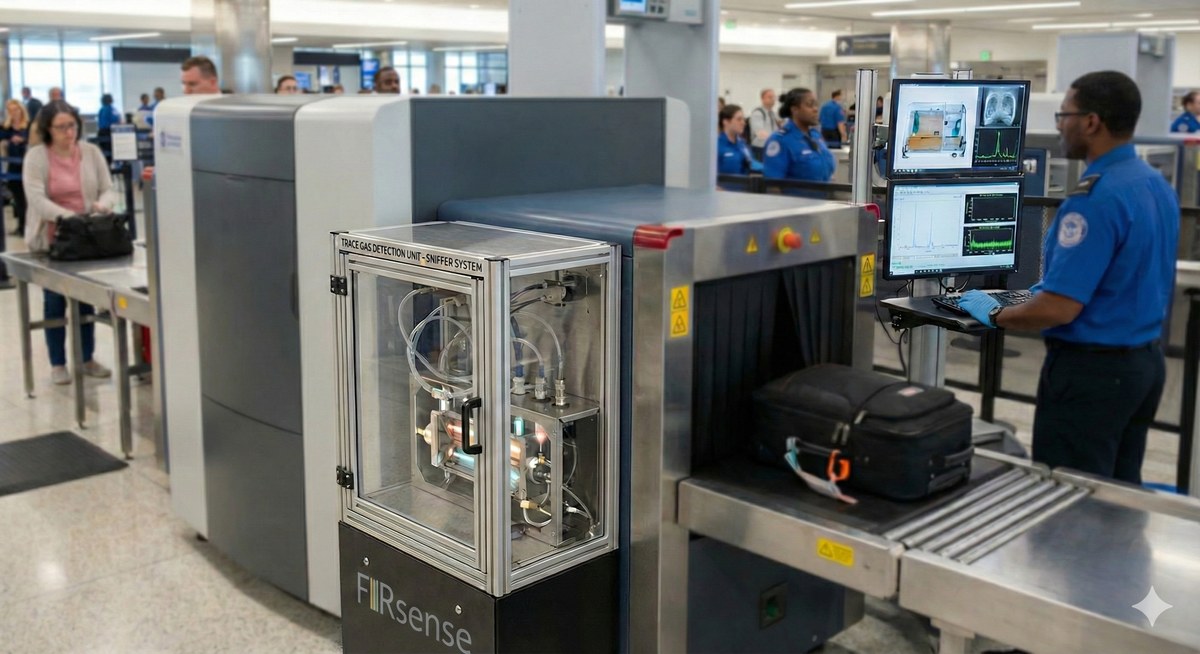
FIRsense device at airport security checkpoint
App 01Checkpoint

Airport security checkpoints

In-line detection at luggage screening points. Replaces swab testing via random sampling. Adds chemical-ID to CT scanners to slash false positives.

Explosives · Drugs · Hazmat
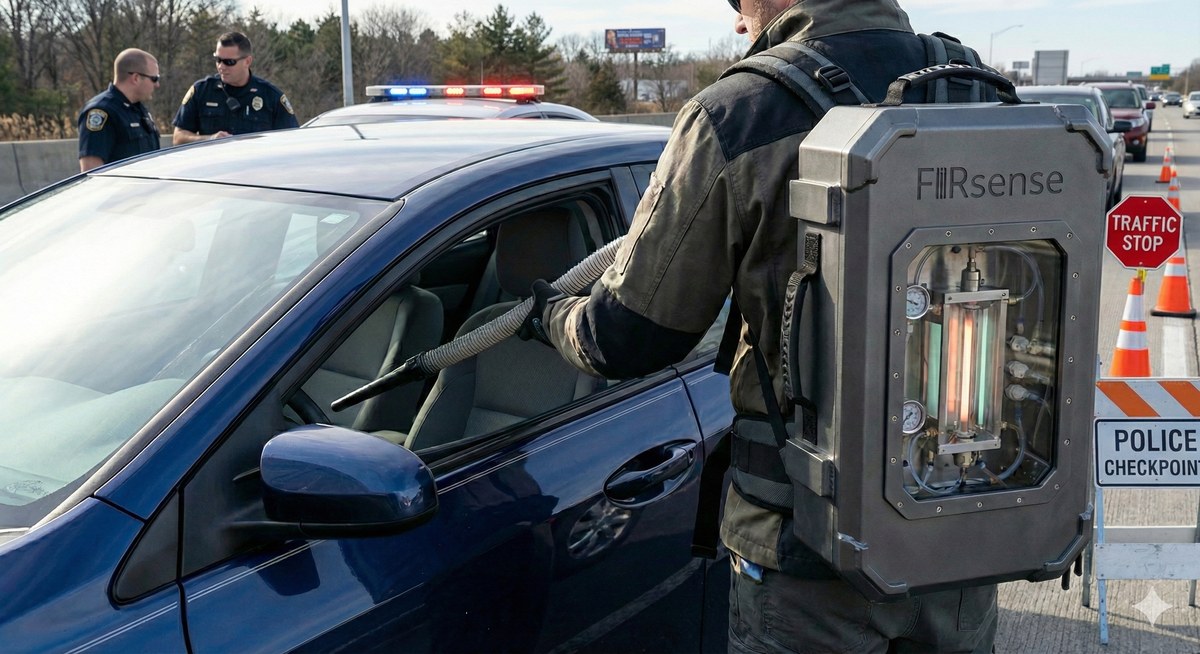
FIRsense mobile backpack device at police checkpoint
App 02Mobile

Mobile narcotics detection

Portable unit for temporary checkpoints, events, and vehicle screening. A consistent, scalable, software-updateable alternative to K-9 and mobile IMS.

Narcotics · Field operations
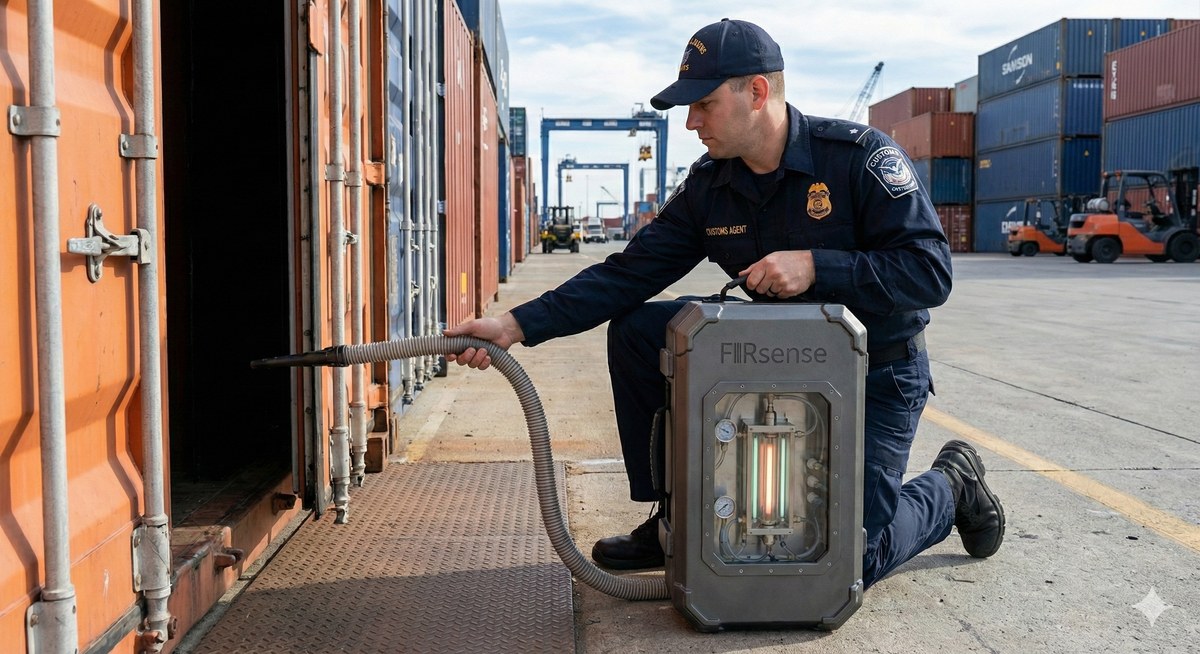
FIRsense device at harbor port screening
App 03Logistics

Borders & freight logistics

High-sensitivity screening at harbors, land borders, and freight airports, at throughput levels where K-9 and mobile IMS aren't viable.

Borders · Supply chain
03 / 07 Our Technology

The missing layer: in-line chemical-ID via THz.

Explosives and narcotics emit trace gases with unique THz absorption signatures. These precise chemical fingerprints let FIRsense's platform continuously monitor ambient air, identifying hazardous substances remotely, in real time, and contactless.

01

Flexible and adaptive

Compounds are identified via an expanding spectral database. New threats can be added by software update, with no hardware change required.

02

Fast and scalable

Continuous air sampling enables real-time detection and eliminates chemical-ID as a throughput bottleneck.

03

In-line by design

Our compact platform integrates into existing checkpoint architectures, adding a chemical-ID layer to physical-only systems.

04

Contactless and remote

Automated air sampling enables fully contactless, remote detection. It reduces manual effort and risk to personnel.

THz Source Gas Cell Detector Database Target molecule Package Pump Tunable narrow source Intensity Frequency Fingerprint Frequency Absorption
Validated · Prototype #3 · Dec 2025

University of Leeds

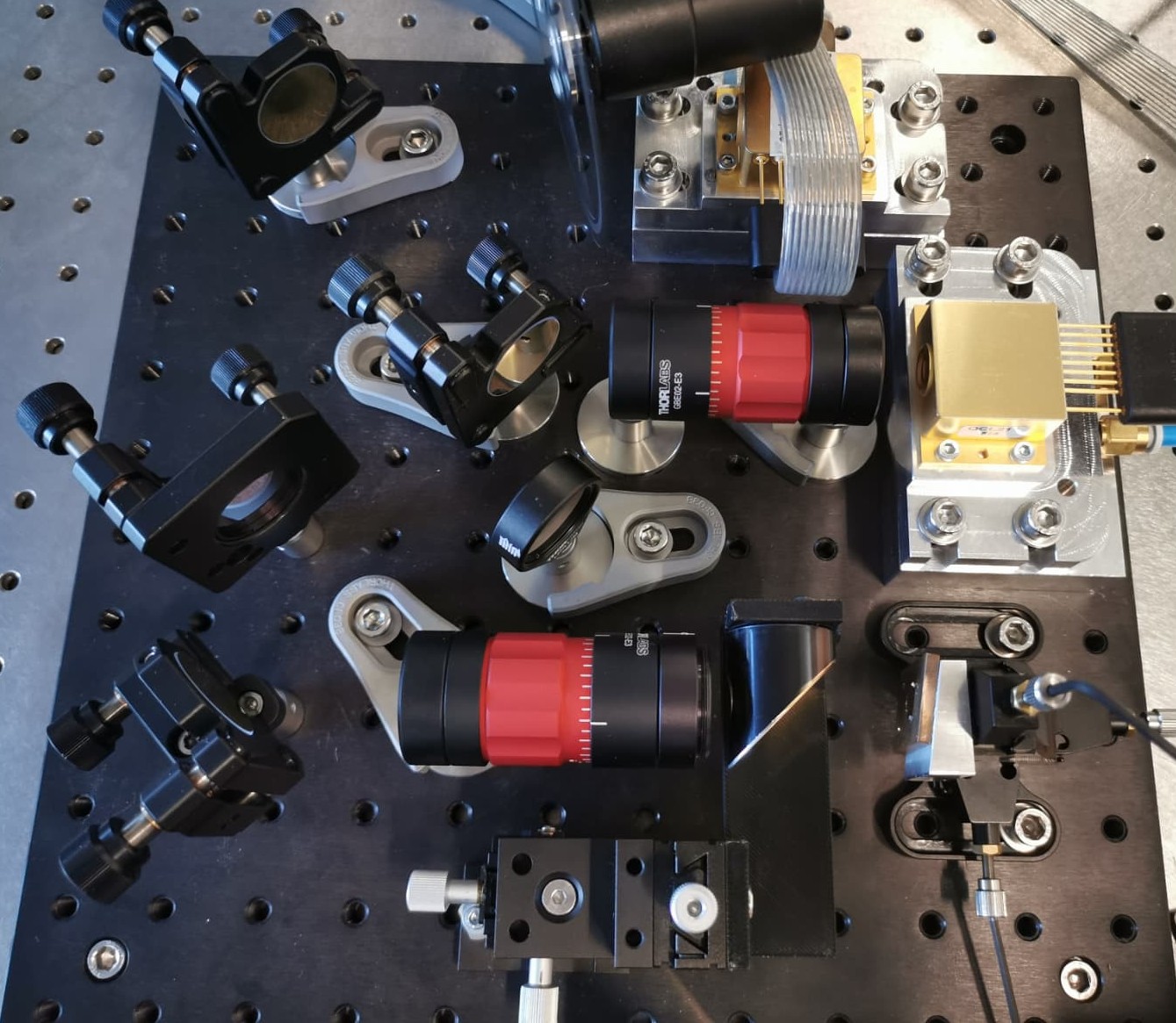
Chemical ID of vapor gases demonstrated on a portable 30×30 cm bench top system at room temperature, achieving a 100 ppm sensitivity baseline.

FIRsense prototype on the optical bench at the University of Leeds

We operate where no one else can.

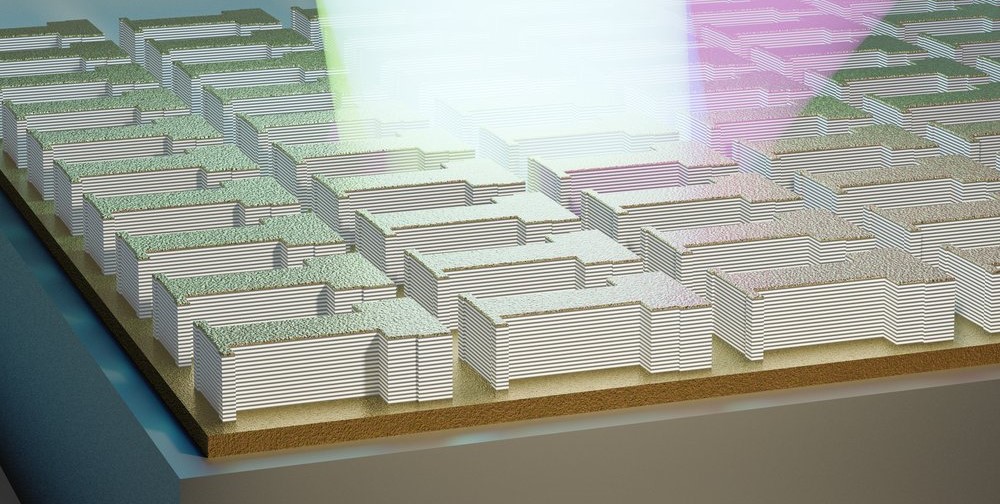
The sharpest, most selective chemical fingerprints of explosives and narcotics sit in the terahertz band, which has until now remained largely inaccessible to both electronic and optical sources. This is the terahertz gap.

FIRsense closes it for the first time with patented metasurface technology, unlocking the THz spectrum for real-world trace gas detection.

FIRsense · 1 – 15 THz · room temperature One continuous source. Closing the gap.
01 · Unlocking

Unlocking the THz gap

Our patented metasurface is the first room-temperature source to cover the full 1–15 THz gap, where the most distinctive molecular absorption lines are found.

02 · Fingerprinting

Molecular fingerprinting

Fully tuneable with high output power, both required to resolve the rich absorption fingerprints of explosives and narcotics.

03 · Real-world

Built for the real world

Room-temperature operation with narrow linewidth. Resolves complex spectra even in ambient air with moisture and interfering compounds.

04 / 07 Platform Outlook

One source.
Countless markets.

Our THz platform unlocks sensing capabilities unavailable in any other frequency range. Below is how we think about the market stack, from the commercial wedges driving near-term revenue to the platform-enabled research frontiers.

Tier 1

Primary applications

The commercial wedges. Active LOIs, committed partners, and near-term revenue paths.

Stored-agriculture quality control

Continuous mycotoxin and spoilage-MVOC fingerprinting (geosmin, 1-octen-3-ol, aflatoxin markers) inside silos, shipping containers, and cold chains, catching contamination and decomposition long before conventional sampling can.

Process Analytical Technology (PAT)

Real-time multi-species off-gas monitoring of bioreactors and fermenters (CO₂, O₂, ethanol, methanol, ammonia, metabolites) for tighter process control, faster batch release, and GMP-grade visibility.

Tier 2

Emerging applications

Active exploration with clear technical fit and initial customer or KOL signal. On the roadmap, not yet the core commercial focus.

Fragrance, flavor & cosmetics QC

Identification and quantification of volatile compound profiles in perfumes, flavor mixes, and cosmetic formulations, replacing slow GC-MS workflows with a single continuous spectroscopic fingerprint.

Space & atmospheric science

Tunable 1–15 THz room-temperature CW source for atmospheric remote sensing, heterodyne astrophysics receivers, and planetary molecular spectroscopy. Replaces cryogenic and narrow-band legacy sources on future Earth-observation and planetary missions.

Industrial process safety

Multi-species leak and hazard detection (HF, HCl, NH₃, SO₂, Cl₂, and organic solvents together) for chemical, semiconductor, and energy plants, where commodity single-gas sensors miss cross-reactive chemistries.

Tier 3

Platform-enabled use cases

Research and exploratory applications demonstrating the breadth of the FIRsense platform. Available for collaboration, pilot projects, and academic partnerships.

Breath diagnostics

Non-invasive disease-marker screening (oncology, respiratory, metabolic, infectious, and GI indications) via ultra-narrow-linewidth detection of trace volatile organic compounds in human breath.

Semiconductor wafer metrology

Contactless sub-surface characterization of dopants, layer thicknesses, and buried defects in advanced-node wafers, exploiting THz transparency through silicon.

Recycling & polymer sorting

Broadband identification of polymers, including black and carbon-filled plastics invisible to NIR sorters, enabling closed-loop recycling streams for the circular economy.

Telecom & 6G research

Tunable THz signal generation for 6G channel sounding, wireless backhaul testbeds, and next-generation communications research.

Primary — active commercial path Emerging — on the roadmap Platform-enabled — research partnerships
05 / 07 The Science

The physics behind FIRsense.

Developed at the Walter Schottky Institut in Garching, at the intersection of optics and semiconductor technology. Hover over each component below to see its role in THz generation.

Mid-IR Laser 1 f₁ SOURCE · 01 Mid-IR Laser 2 f₂ SOURCE · 02 Optical combiner LENSES · MIRRORS · FILTERS Metasurface DFG · MQW · PATENTED THz emission ν_THz = |f₁ − f₂|
Component overview

Mid-IR pump sources

Two mid-IR lasers at frequencies f₁ and f₂ are combined and fed into the metasurface. Via difference-frequency generation, THz radiation emerges at exactly |f₁ − f₂|.

Precise control of the pump lasers directly defines the THz output. This is the foundation for tunable, selective spectroscopy.

<5 MHz
Linewidth
0–15 THz
Tuning range
20 µW
Output power
295 K
Operating temp.
06 / 07 Milestones

Three prototypes built.
Customer pilot by Q4 2026.

Core THz source technology derisked. Now transitioning into product development and commercialisation.

2023 – 2024

Metasurface research

Design and fabrication at WSI, TU Munich. 1–12 THz tunability, up to 20 µW CW output power.

2025

Scientific validation

University of Leeds. First low-pressure H₂O at 6–10 THz. 5 MHz resolution, 10+ vapor gases.

2026 Q1 – Q3

MVP Alpha & demonstrator

Demonstrator unit, 10 target analytes recorded, MVP Alpha built. Field testing with industry partners.

2026 Q4

Customer pilot

First customer pilot with committed partners. Continuous database expansion, field-feedback iteration.

07 / 07 Latest News

Building momentum in THz innovation.

Recent milestones, awards, and recognition on our journey from lab to market.

PublicationApr 2026

Nature Photonics Publication

Our peer-review paper demonstrates record generation of continuous-wave 1–11 THz radiation.

Read paper →
AcceleratorMar 2026

Accepted in XPlore Venture Creator Batch 1/2026

Selected for one of Munich's leading deep-tech incubator program, providing mentorship, prototyping access, and go-to-market support.

Archive entry
AwardMar 2026

TUM Innovation Award finalist

Recognised among the top deep-tech ventures at TU Munich's annual innovation competition for our novel metasurface THz source.

Archive entry
Founding team People

Meet the experts.

FIRsense originated at the Walter Schottky Institut, TU Munich. Our patented metasurface was developed during Jonas Krakofsky's PhD in the group of Prof. Mikhail Belkin, who continues to support the company as scientific mentor. The team combines THz physics, photonics, spectroscopy, hardware, and deep-tech commercialisation.

Dr. Felix Rauh

Dr. Felix Rauh

CEO & Co-founder

Former consultant and product manager at Nanogami with 3+ years leading deep-tech development teams. Bridges commercial strategy and technical execution.

Jonas H. Krakofsky

Jonas H. Krakofsky

CTO & Co-founder

Expert in THz source design and manufacturing with 7+ years of research experience at Walter Schottky Institute. Principal architect of FIRsense's metasurface technology.

Team & Advisors

Supporting the founding team across metasurface design, hardware, spectroscopy, and scientific mentorship.

Markus Rieder
Markus Rieder
Metasurface Design & Nanofabrication

Developed novel THz metasurfaces during his Master's at WSI. Supports FIRsense in metasurface design.

markus.rieder@firsense.de
Simon Schmid
Simon Schmid
Hardware Engineer

Built the first portable prototype at WSI in his Master's thesis. Responsible for system assembly, CAD design, and hardware commissioning.

simon.schmid@firsense.de
Naim Tahsin
Naim Tahsin
Communications Market

Former Staff Engineer at Qualcomm with 10 years of RF industry experience. Leads FIRsense's expansion into telecommunications.

naim.tahsin@firsense.de
Lina Todenhagen
Lina Todenhagen
Systems & Applications Engineer

Finishing her PhD in quantum sensing. Leads translation of core technology into measurement systems and builds the spectral database.

lina.todenhagen@firsense.de
Prof. Mikhail Belkin
Scientific Mentor

Professor with decades of expertise in metasurfaces and THz technology. Advises FIRsense on all matters of science and technology.

Ecosystem Partners

Backed by Europe's strongest deep-tech ecosystem and leading researchers.

Strong institutional partners across venture creation, academic research, and international scientific validation.

Venture Creator & Investor

XPlore Venture Creator provides go-to-market support and a network of deep-tech operators to accelerate FIRsense's commercialisation path.

TU Munich Startup Lab

TUM Venture Labs Semicon provides infrastructure, mentoring, and ecosystem access for semiconductor and photonics startups within the TU Munich network.

Research Partner · Home Lab

World-leading semiconductor research institute at TU Munich. Fabrication home of FIRsense's patented metasurface and host to Prototypes #1 and #3.

Scientific Partner · UK

Host of Prototype #3 validation (Dec 2025). Independently confirmed <5 MHz spectral resolution and identification of 10+ target vapor gases at room temperature.

Let's discuss what closing the THz gap means for your work.

Whether you are an investor, a partner, or a collaborator, we would be glad to walk you through the technology, validation data, and roadmap to first pilot.